
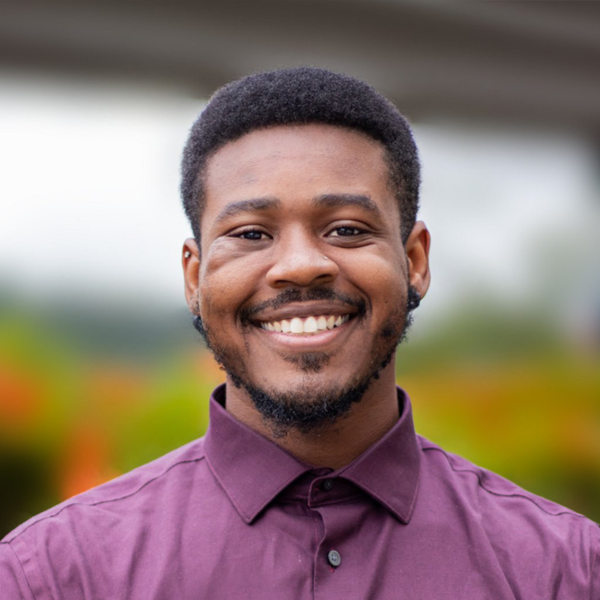
Keeping the Heart Open: Corey Collins' Journey from Survival Mode to Purpose
Corey Collins was 28 years old when he almost walked away from something that would change his life.
He’d been introduced to Quantum Leap by his mentor Scott Lebhar at a nonprofit called Just In Time for Foster Youth. The GPS workshop had caught his attention — he was in a season of life where he wanted more structure, more accountability, a clearer path forward. But when he showed up, there was a problem: the scholarship program had an age cutoff of 28. Scott told him he might not qualify.
Corey decided to show up anyway. “The scholarship wasn’t even the forefront of my mind,” he says. “The skills and the mindset and the strategies that Quantum Leap introduces to you — that’s beneficial for a lifetime.”
A few months later, KW Next Gen raised the age cutoff to 29. Corey and Scott were in the office together when they found out. “We were just like — that’s a God shot,” Corey says. “It felt like this was something that was meant for me to do.”
He had no idea how right he was.

What came next was not a straight line.
Around the same time Corey began coaching with Brittany Staton, he lost his job. He wasn’t just dealing with a career disruption — he was confronting something much deeper. A lifetime of growing up fast, of being a provider, of operating from a place of scarcity had left him in survival mode. When the job disappeared, the armor he’d built around himself started to crack.
“I felt like I had nothing to really offer this world,” he says. “I didn’t think I was going to make it — emotionally.”
He got vulnerable with Brittany in a way he hadn’t expected. There were sessions where he was in tears. She didn’t soften the reality for him — she put it in front of him: You’ve done these things. You have the resources. You have the network. Stop making excuses.
“She helped me recognize,” Corey says, “that I’ve been through worse — and I’m not there anymore.”

Slowly, something started to shift.
His mission statement — written in the MVVBP workshop — had been the same from the beginning: to inspire, heal, and uplift others utilizing the power of music and his voice. He’d always known music was part of who he was. What he hadn’t been willing to do was act like it.
“Everything that kept coming up was just — I do have the time, but I really wasn’t making the time to do it,” he says. “I was so distracted. Insecure about my own voice, insecure about succeeding. I would just stop myself.”
So he took baby steps. He enrolled at Berklee School of Music for audio production. He started vocal coaching. He said yes when his coach put him on stage — three times now, his first time ever performing in front of an audience. The first concert was terrifying. He went flat. He was hard on himself. He was also proud.
“I keep going,” he says. “And it gets better, and it gets easier.”

What Corey wanted out of the program shifted as he grew into it. The goal that started as wanting to release a small EP for friends and family evolved once he understood what was really driving him. He didn’t just want to make music. He wanted to heal people with it.
That realization pointed him somewhere new. Today, Corey is a program manager at a mental health facility, supporting adolescents and adults through mental health challenges and medication management. It’s his first leadership role — and the coaching, he says, is part of why he believed he could do it. He’s also back in school finishing a psychology degree. He already has one in computer science. He’s going back for psychology because he’s working toward becoming a licensed music therapist.
“I never wanted to be famous,” he says simply. “I just want to know I made an impact. When I see the lights come on in someone who’s been struggling — that’s so rewarding.”

There’s a thread that runs through Corey’s whole story that he keeps coming back to: the fear of having a big heart. Of caring openly in a world that doesn’t always reward it.
“I was so scared to have this big heart,” he says. “The world can sometimes put a damper on things. But I keep reminding myself — don’t close your heart out. People need you. People need your inspiration.”
He still has the Quantum Leap handbook at his house. He opens it when he needs a reminder of what he’s capable of. Because the way Corey sees it — and the way he’s heard Gary Keller say it — the internal life is what the external life reflects. Get right on the inside, and the outside starts to follow.
Corey Collins is 30 years old. He’s performing on stages, leading a team, and studying to help people heal through music. He almost walked away from the program that helped him find all of it.
He’s glad he didn’t.